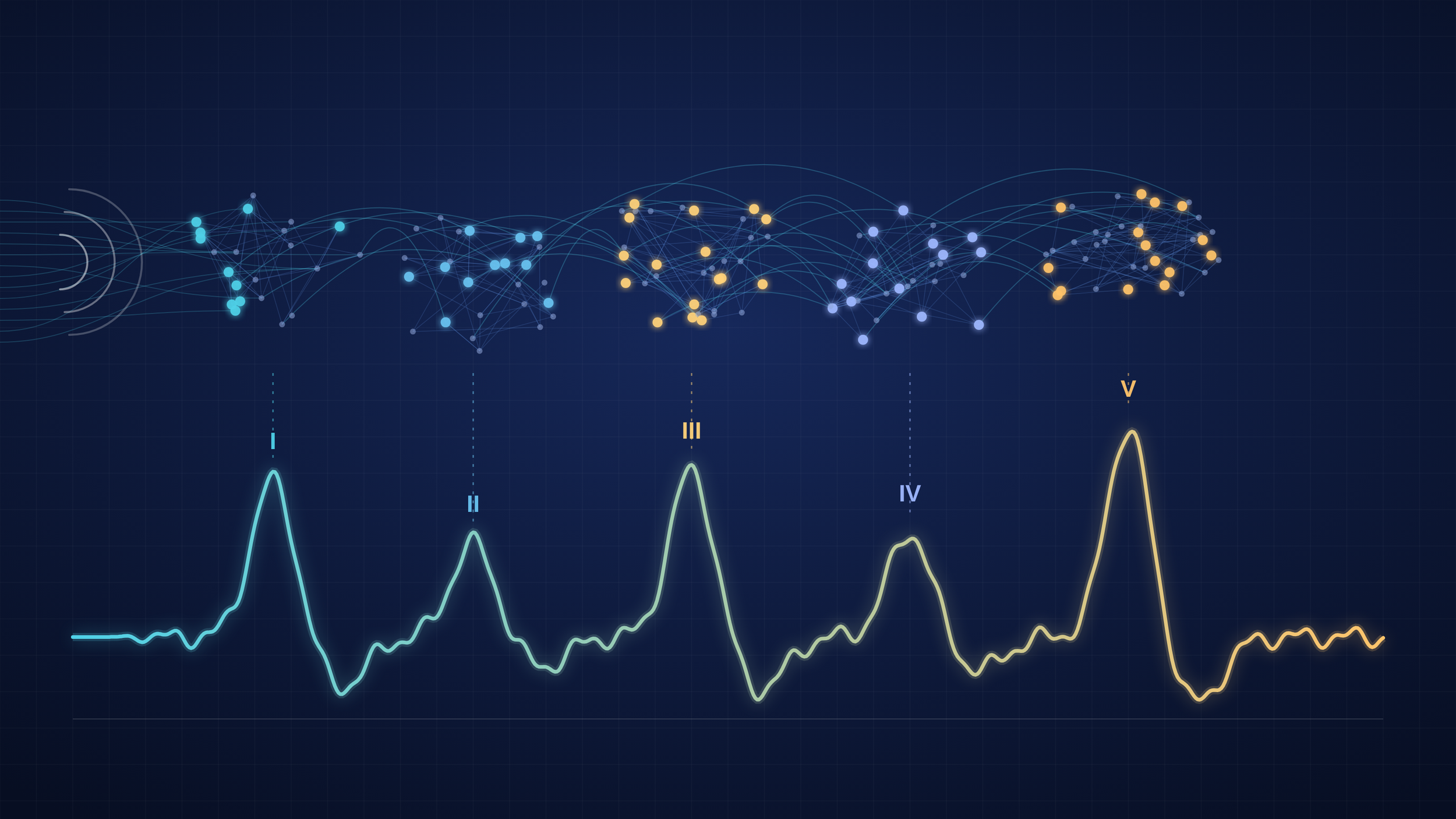
What if we could study hearing inside a computer? Our lab has taken a big step in that direction. In a new study published in the Journal of the Association for Research in Otolaryngology, our team built a computer model of the auditory brainstem. This is the part of the brain that first processes sound. The model reproduces one of the most widely used hearing tests in medicine, and it helps us see what is going wrong inside the brain when that test looks unusual.
That test is the auditory brainstem response, or ABR. Doctors use it every day, including to screen newborn babies. A few small sensors on the head pick up the brain's electrical response to clicks or tones, and the result is a wavy line with a series of peaks. Each peak reflects activity at a different stop along the hearing pathway. The ABR is quick, painless and very useful. But it has a big limitation. It averages the activity of many thousands of nerve cells into one signal, so a change in the peaks shows that something is different without showing what that something is.
-
So we built a virtual version of the brainstem circuit. It is made of simulated nerve cells that fire and talk to each other much like real ones do, scaled up to the size of a real neural population. From all that activity, the model produces its own ABR. Then we tested it against two conditions we know well: autism and aging.
In a mouse model of Fragile X syndrome, a leading genetic cause of autism, the simulation showed how problems with myelin (the insulation around nerve fibers) and overly excitable nerve cells could produce the changes in the ABR seen in real recordings. In aging gerbils, the model pointed to reduced activity in a specific brainstem relay station called the medial nucleus of the trapezoid body. We then checked this prediction with microscope imaging, and the imaging data supported it.
Why does this matter? Lab experiments on hearing take a long time. They require careful animal work, specialized equipment and months of analysis. A reliable computer model lets us test ideas in silico, meaning on the computer, first. We can ask "what if" questions in hours instead of months, and then focus our experiments on the ideas most likely to pay off. Over time, this approach could help researchers find the causes of hearing problems faster and, one day, help clinicians get more information out of a test patients already take.
The study was led by Dr. Ben-Zheng Li, a former postdoctoral fellow in our lab, together with Shani Poleg, Matthew Ridenour, Dr. Daniel Tollin, Dr. Tim Lei of CU Denver, and Dr. Achim Klug.
Read the paper: Li BZ, Poleg S, Ridenour M, Tollin D, Lei T, Klug A. Computational Model for Synthesizing Auditory Brainstem Responses to Assess Neuronal Alterations in Aging and Autistic Animal Models. J Assoc Res Otolaryngol. 2026;27(5):771-784. doi:10.1007/s10162-026-01060-0