Picture yourself in a quiet room when a door slams. You jump. That quick, automatic flinch is called the startle reflex. Now imagine you heard a faint sound a split second before the slam. Your jump would be smaller. Your brain got a small warning, and it softened the startle.
That simple effect is called prepulse inhibition. In our new study, published in Hearing Research, we used it as a powerful way to measure how well animals hear. The project was a collaboration with the laboratory of our colleague Dr. Daniel Tollin at CU Anschutz, and we are excited to have been part of it.
-
We worked with the Mongolian gerbil, a small rodent that is a favorite in hearing research for a good reason. Unlike mice and rats, gerbils hear low-pitched sounds well, much like people do. That lets them use the same tricks we use to figure out where a sound comes from. They compare tiny differences in timing and loudness between their two ears.
Until now, testing these skills in gerbils was slow work. Animals had to be trained for long periods to respond to sounds in specific ways, such as pressing a lever or moving to a spot. A full picture of an animal's hearing meant training it on several different tasks, one after another. That process could take many months and made it hard to test large groups of animals.
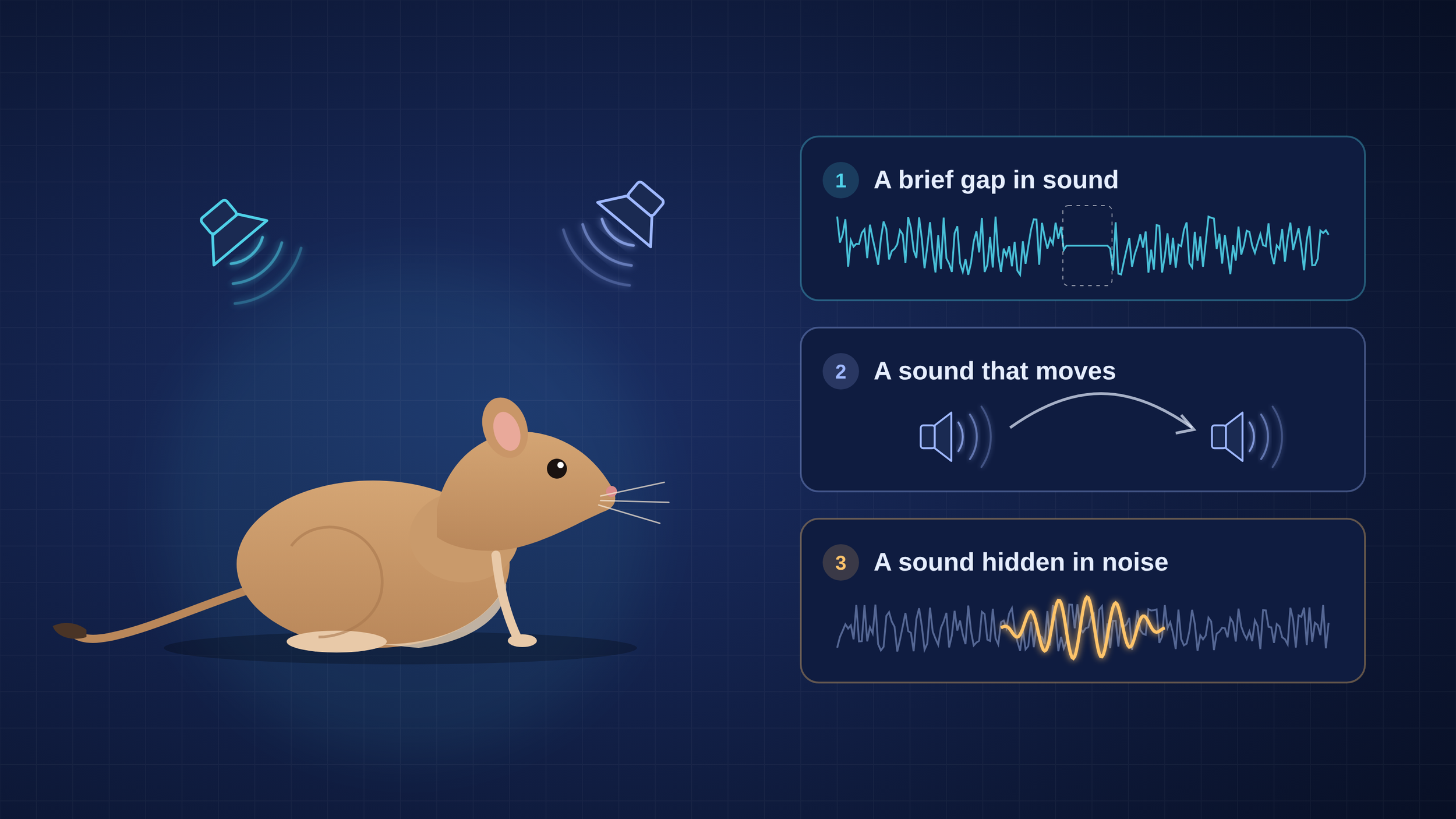
The startle approach needs no training at all. We played a loud, startling sound and, just before it, a subtle sound cue. If the gerbil noticed the cue, it startled less. We tested three kinds of cues:
A very brief silent gap in an ongoing sound
A sound that suddenly changed where it was coming from
A target sound mixed in with background noise
In all three tests, the gerbils' startle got smaller as the cue got easier to detect. That steady relationship let us pinpoint each animal's threshold, the smallest cue it could reliably notice. Then came the key comparison. The thresholds we measured this way matched those from earlier studies that relied on months of training.
Why does this matter? It gives us a faster and more practical way to measure hearing in many animals at once. It covers how well they track sounds in time, how precisely they can tell where a sound comes from, and how well they pick out a sound in a noisy setting. These skills are often affected in hearing loss, aging, and developmental conditions. A quicker way to measure them could speed up research on all of these.
The study was led by first author Matthew Sergison, a graduate student in the Neuroscience Graduate Program at CU Anschutz, together with Shani Poleg, Dr. Nathaniel Greene, Dr. Achim Klug, and Dr. Daniel Tollin.
Read the paper: Sergison MD, Poleg S, Greene NT, Klug A, Tollin DJ. Spatial hearing and temporal processing ability of the Mongolian gerbil (Meriones unguiculatus) measured using prepulse inhibition of acoustic startle. Hear Res. 2026;470:109507. doi:10.1016/j.heares.2025.109507