A computer model is only useful if it can tell us something new. In our latest study, published in Neuroscience Letters, our virtual brainstem did exactly that. It made a prediction about how the brain responds to sound. Then we tested that prediction in real animals, and it held up.
The study centers on the auditory brainstem response, or ABR. This quick, painless test measures the brain's electrical response to sound through small sensors on the head. The result is a wavy line with five main peaks, labeled I through V. Each peak comes from a different stop along the hearing pathway, starting with the auditory nerve and moving up through the brainstem. The sound most often used for this test is a very short click. How short? Usually around a tenth of a thousandth of a second.
That raises a simple question that, surprisingly, has not been fully answered. What happens to the ABR when the click gets longer? Clinics and labs do not all use the same click settings, so the answer matters for comparing results.
-
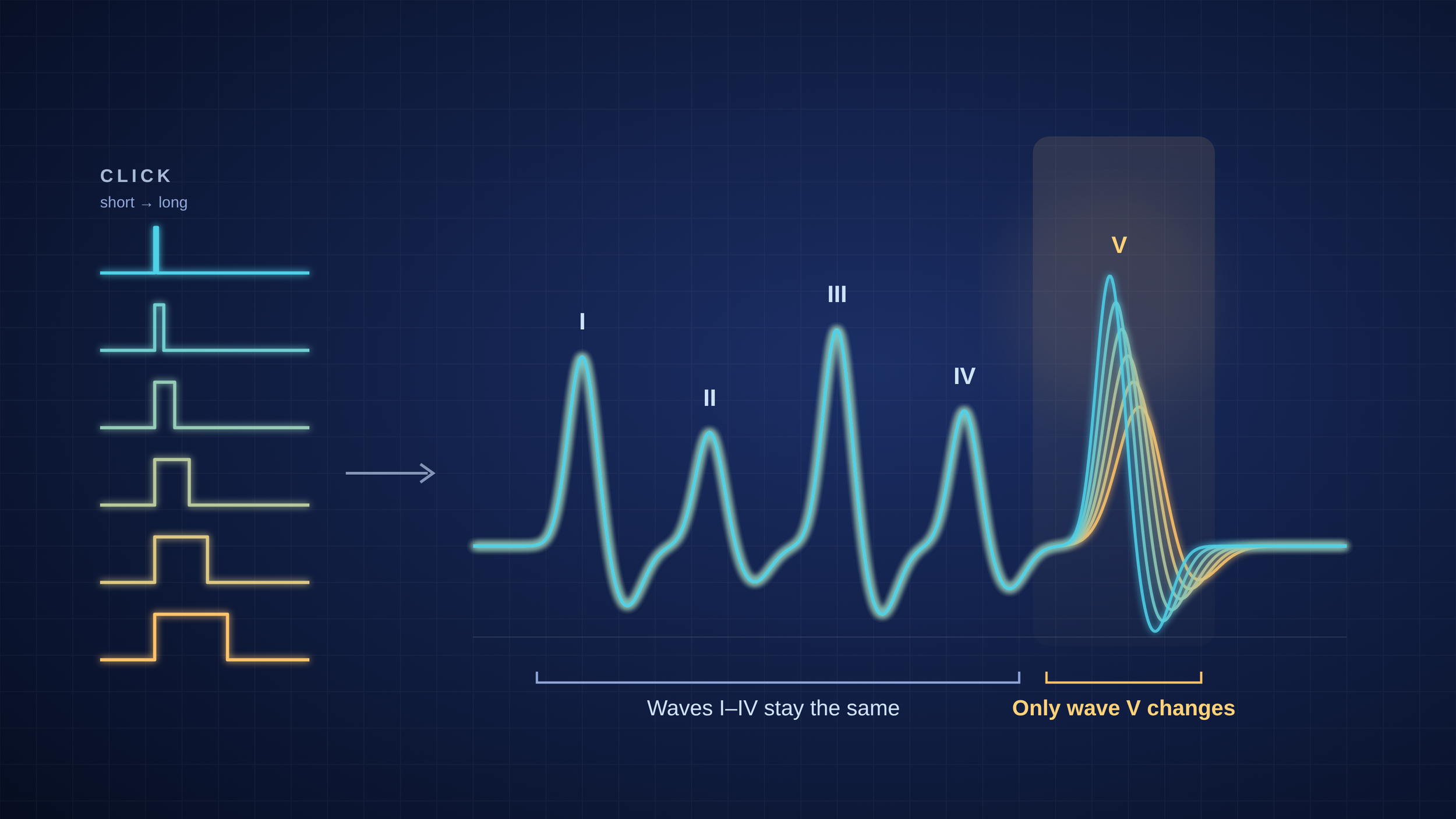
We put the question to our computer model of the auditory brainstem first. It simulates networks of nerve cells that fire and communicate like real ones. We played it virtual clicks ranging from 0.1 to 2 milliseconds long. The model made a clear and specific prediction. The first four peaks would stay the same. Only wave V, the last peak, would change.
Next came the real test. We recorded ABRs from gerbils, a species widely used in hearing research, using the same range of click lengths. The results matched the prediction. As the clicks got longer, the size of wave V and the time between waves IV and V changed in a consistent way. The earlier waves did not.
Why would only the last peak care about click length? The early waves come from the auditory nerve and lower brainstem, which mainly respond to the very start of a sound. Wave V comes from higher up, including a structure called the inferior colliculus. That region appears to add up sound information over a longer window of time, so it notices when a click is stretched out.
This study matters for two reasons. First, it helps clarify how one basic test setting shapes the ABR, which can help researchers and clinicians interpret their recordings. Second, it shows that our model does more than reproduce what we already know. It can make predictions that turn out to be right. That is exactly what we need from a tool meant to speed up the search for what goes wrong in hearing disorders.
The study was led by Dr. Ben-Zheng Li, together with Shani Poleg and Dr. Achim Klug.
Read the paper: Li BZ, Poleg S, Klug A. Evidence for wave-specific effects of click duration on auditory brainstem responses: Modeling and experimental validation. Neurosci Lett. 2026;886:138714. doi:10.1016/j.neulet.2026.138714
The headline and some of the wording link this release to the earlier one about the model, in case you post them close together. The line saying clinics and labs do not all use the same click settings is my framing and does not come from the abstract, so please check that it matches how you would put it.
Source: PubMed, PMID 42665208, DOI